



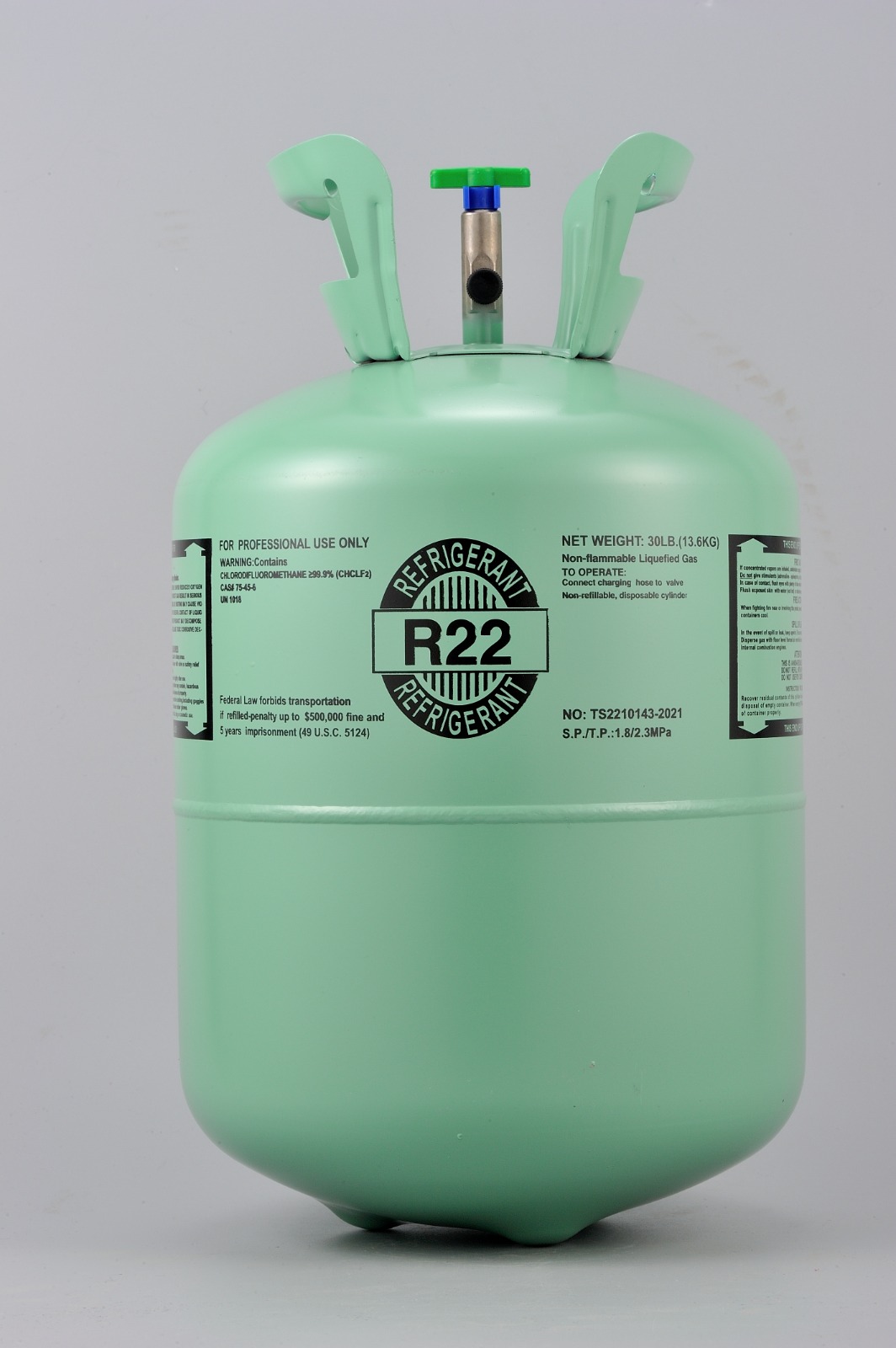
R-22
R-22 is an HCFC refrigerant widely used in residential, commercial, and industrial air-conditioning systems. Known for its stable performance and efficiency, R-22 operates under high pressure with low compressor displacement. Despite its historical popularity, its production and use are being phased out globally to protect the ozone layer, encouraging a transition to eco-friendly alternatives such as R-407C, R-422D, or R-507.
In addition to its role in cooling systems, R-22 serves as an intermediate compound in the production of fluoropolymers and as a blowing agent in rigid foam manufacturing.
Key Applications
- Residential and commercial air-conditioning units
- Industrial cooling systems
- Production of fluoropolymers
- Blowing agents in rigid foam manufacturing
Product Highlights
- Refrigerant Type: Pure HCFC fluid
- Lubrication: Compatible with mineral oil
- Charging Method: System must be evacuated before charging
- Flammability: Non-flammable at ambient temperature and pressure
- Odor: Ether-like smell
- ASHRAE Safety Classification: A1 (non-toxic, non-flammable)
Physical Properties
| Property | Description |
|---|---|
Chemical Name | Chlorodifluoromethane |
Chemical Formula | CHClF₂ |
Physical State | Gas |
Form | Liquefied gas |
Odor | Slight |
Color | Colorless |
pH | Neutral |
Water Solubility (g/l) | 3 |
Average Molecular Weight (g/mol) | 86.5 |
Melting Point (°C) | -60 |
Normal Boiling Point (°C) | -41.5 |
Critical Temperature (°C) | 205.06 |
Critical Pressure (psia) | 723.74 |
Vapor Pressure | 9,384 hPa @ 21.1°C |
Vapor Density (Air = 1.0) | 3 |
Density | 1.21 g/cm³ @ 21.1°C |
Density of Saturated Liquid @ 25°C (lb/ft³) | 73.1 |
Specific Heat of Saturated Vapor @ NBP (BTU/lb °C) | 0.31 |
Specific Heat of Saturated Liquid @ 25°C (BTU/lb °C) | 0.13 |
Ozone Depletion Potential (ODP) | 0.055 (CFC 11 = 1.0) |
Global Warming Potential (GWP) | 1700 |
CFC
|
Name |
Color |
Type |
Description |
|---|---|---|---|
| Floe® R-22 | R-22 | Floe® R-22 is an HCFC refrigerant that operates with high pressure but low compressor displacement. Floe® R-22 is popular in residential, commercial and industrial applications. Floe® R-22 is also used as an intermediate to produce fluoropolymers and as a blowing agent in rigid foam applications. | |
Handling and Safety Information
- Keep away from ignition sources and prevent static discharge.
- Protect cylinders from physical damage and avoid dropping or rolling.
- Open valves slowly; close tightly after each use.
- Never apply direct heat or flame to the cylinder.
- Avoid breathing concentrated vapors or allowing liquid contact with skin or eyes.
- Store in well-ventilated areas away from sunlight, fire risks, and heat sources.
- Keep cylinders below 45°C and away from open drains, boilers, or air intake systems.